It’s October, and the Atlantic has been unusually quiet. As of October 1, 2026, not a single hurricane had formed in the Atlantic basin this season, largely because of a record-strength El Niño. That is good news for Florida.
It is also the kind of season that makes it easy to put off home projects for another year.
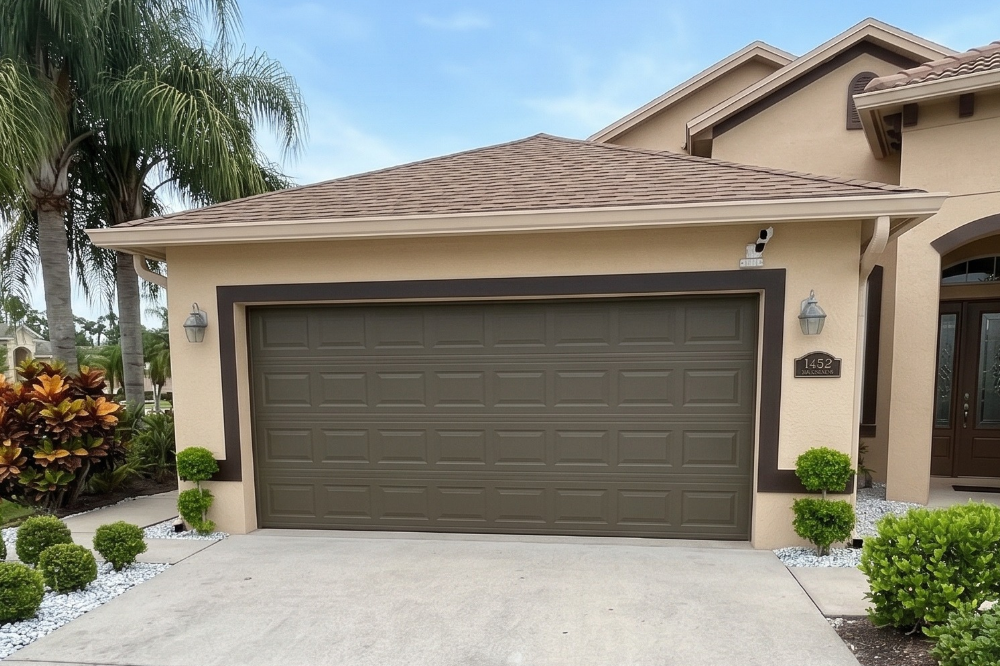
One part of your home deserves attention no matter what the forecast says: the garage door. A hurricane garage door in Florida is not a luxury upgrade. It is often the difference between a home that holds together in high wind and one that fails from the inside out. It also plays a direct role in whether you receive the full opening protection credit on your wind mitigation report.
The Hurricane Safety Program helps homeowners in Miami-Dade, Broward, Palm Beach, and Tampa understand where their home stands and fix what is holding it back. Here is what you need to know about the largest opening on most Florida homes.
Why the Garage Door Is the Biggest Weak Point on Most Homes
A typical two-car garage door is around 16 feet wide. That is a lot of surface for wind to push and pull against, and in many homes it is the least reinforced opening on the house.
When a garage door fails during a storm, the problem does not stay in the garage. Wind rushes into the structure and pressurizes it from the inside. That pressure pushes up on the roof and out on the walls at the same time the storm is pulling on them from outside.
Building researchers have studied this pattern for decades:
- The Insurance Institute for Business & Home Safety (IBHS) classifies garage doors as “damage amplifiers,” meaning their failure can trigger much larger structural damage.
- Post-storm field studies after Hurricane Ike and two major tornadoes found that only about 10 percent of homes whose garage door stayed intact also had structural roof damage.
- After Hurricane Harvey, IBHS researchers found that single garage doors failed more often than double doors, a reminder that smaller doors are not automatically safer.
- FEMA’s report on Hurricane Andrew identified garage door failure as a key factor in roof decks blowing off homes in South Florida.
Garage doors do not only fail by being pushed in. Negative pressure on the back side of a home can pull a door out of its tracks. That is why a rated door is tested for both directions of force.
What Florida Requires for Garage Doors
Florida does not have one garage door rule for the whole state. Requirements depend on where your home sits and how exposed it is to wind.
Miami-Dade and Broward (High-Velocity Hurricane Zone)
Miami-Dade and Broward counties fall within the High-Velocity Hurricane Zone (HVHZ), which carries the strictest wind and impact standards in the country.
- New garage doors must carry a Miami-Dade Notice of Acceptance (NOA) or Broward County product approval.
- Doors must be impact-rated, not just wind-rated.
- The approval covers the door as a complete tested system, including the panels, tracks, and hardware.
Palm Beach, Tampa Bay, and the Rest of Coastal Florida
Outside the HVHZ, garage doors need a Florida Product Approval number and a design pressure rating that matches the local wind speed and exposure. Homes in wind-borne debris regions, which cover much of the Florida coast, may also need impact-rated doors or an approved form of protection.
Permits Are Part of the Deal
Garage door replacement requires a permit in virtually every Florida jurisdiction. Plan reviewers check product approval numbers against official databases. A door installed without a permit can create problems later, both for code compliance and for insurance documentation.
One more date to keep in mind: the 9th Edition of the Florida Building Code takes effect December 31, 2026. Permitting and product approval requirements for garage doors remain in place under the new edition.
Wind-Rated vs. Impact-Rated: Not the Same Thing
This is one of the most common points of confusion for homeowners shopping for a new door.
Wind-rated means the door has been tested to resist a specific design pressure, measured in pounds per square foot (PSF). You will usually see it written as a positive and negative number, such as +40/-45. The positive number is pressure pushing in. The negative number is suction pulling out.
Impact-rated means the door also passed a large missile test. In this test, a piece of lumber is fired at the door at roughly 50 feet per second to simulate flying debris. The door must survive the hit and then hold up under repeated pressure cycles.
A door can be wind-rated without being impact-rated. In Miami-Dade and Broward, you need both. For wind mitigation purposes anywhere in the state, impact rating is what typically counts toward opening protection.
How Your Garage Door Affects Your Wind Mitigation Credit
The Florida wind mitigation inspection form, OIR-B1-1802, includes an opening protection category. It looks at every exterior opening on the home: windows, entry doors, sliding glass doors, skylights, and garage doors.
Here is the part many homeowners miss. The opening protection rating is based on the weakest opening. A home can have brand new impact windows and impact entry doors, but if the garage door is not rated or protected, the home may not qualify for the top opening protection credit.
This happens more often than you might think. Homeowners replace windows first because they are the most visible upgrade, then assume the job is done. The inspector arrives, finds an older garage door with no label, and the credit drops.
Inspectors also need proof. That usually means a visible product label, a product approval or NOA number, and a closed permit. If any of those are missing, the inspector may not be able to give the opening credit, even if the door itself is strong.
How to Check Your Garage Door in About 10 Minutes
You do not need to be a contractor to get a rough idea of where your door stands. Walk into your garage and look for the following:
- The label. Most rated garage doors have a sticker on the inside of a panel or along the edge of the door. IBHS puts it simply: if there is no label, you do not know whether the door is wind-rated.
- Design pressure numbers. Look for positive and negative PSF values on that label.
- An approval number. Look for a Florida Product Approval number or a Miami-Dade NOA number.
- Impact language. The label should state that the door is impact-rated or rated for wind-borne debris if it is.
- Age. Doors installed before the Florida Building Code took effect in 2002 were generally not built to current wind standards.
- Hardware condition. Check tracks, rollers, hinges, and reinforcement struts for rust, bends, or loose fasteners. A strong door on worn hardware is not a strong door.
- Permit history. Your county or city building department can confirm whether the door was installed under a permit.
If you cannot find a label, or the label is unreadable, assume the door needs a professional evaluation.
Retrofit or Replace?
Not every garage door has to be replaced. Some doors can be reinforced with a bracing kit that is certified for that specific door model. Temporary braces are also available for use before a named storm.
That said, there are tradeoffs to understand:
- Bracing can improve wind resistance but may not give you an impact rating, which is usually what the wind mitigation form needs for opening protection credit.
- Temporary braces only work if someone installs them before the storm. That is not always realistic if you travel, work long hours, or evacuate early.
- Older doors on worn tracks often cost more to keep reinforcing than to replace.
- In Miami-Dade and Broward, a replacement door must meet HVHZ approval, so a non-approved door cannot simply be upgraded into compliance.
For many South Florida homes built before 2002, replacement with an approved impact garage door is the cleaner long-term solution. It addresses both safety and insurance documentation in one project.
2026 Savings Worth Knowing About
Two things can change the math on a garage door project this year.
A sales tax break. Florida created a three-year sales tax exemption for qualifying impact-resistant windows, doors, and garage doors beginning July 1, 2026 and running through mid-2029. Ask how it is applied to your project before you sign.
Insurance credits. If your garage door is the last unprotected opening on your home, upgrading it may help move your opening protection rating up a level on your next wind mitigation report. Results depend on your insurer, your policy, and your home’s other features, so a new inspection after installation is the best way to see the actual impact.
How the Hurricane Safety Program Helps
The Hurricane Safety Program looks at your whole home, not just one product. We start with your roof, then your windows, then your doors, including the garage door, so you know exactly which openings are holding back your protection and your credits.
From there, we handle everything:
- Home assessment to identify which openings are rated, which are not, and which documents are missing.
- Approved products that meet Miami-Dade NOA or Florida Product Approval requirements for your area.
- Permits and final inspections, so every installation is properly documented.
- Professional installation of impact garage doors, impact entry doors, impact windows, and roofing upgrades.
- Documentation for your wind mitigation report, so your inspector has what they need to verify each opening.
- Financing with no upfront cost, so you can protect your home without draining your savings.
Check If Your Home Qualifies
A quiet hurricane season is the best time to fix the weak spots in your home. There is no rush, no storm on the radar, and no scramble for materials or crews.
Find out where your home stands and what upgrades you may qualify for.
Check If Your Home Qualifies →
Prefer to talk to someone? Call us at (888) 369-4536.